How Much MediSave Do Self-Employed Tutors Pay in Singapore?
· 8 min read · By Gregory Tan
If you're a Singapore Citizen or PR and your net trade income from tuition is more than S$6,000 in a year, you must pay MediSave as a self-employed person. For 2025 income, the rate is 4% to 10.5% of your net trade income, depending on your age and how much you earn, up to a cap of S$7,104 to S$9,324 a year. A 38-year-old tutor with S$52,000 of net trade income, for example, pays about S$4,680. The bill comes from the CPF Board months after the year ends, so the safest habit is to put about 8–10% of each month's profit aside as you go.
Here's how it's worked out, what tutors at different levels actually pay, and how to get ready so the notice doesn't come as a shock. This isn't financial advice: the rates change, so check the CPF Board for your own year.
Who has to pay self-employed MediSave
You pay if all three of these are true:
- You're a Singapore Citizen or PR.
- Your tuition is self-employed income. Private tuition you arrange yourself, home tuition through an agency, or classes you run in your own HDB flat all count. If a tuition centre employs you on a salary and pays CPF for you, that part isn't self-employed.
- Your net trade income is more than S$6,000 in the calendar year. That's roughly S$500 a month of profit, which is about two P5 Maths students at S$60 a lesson once a week.
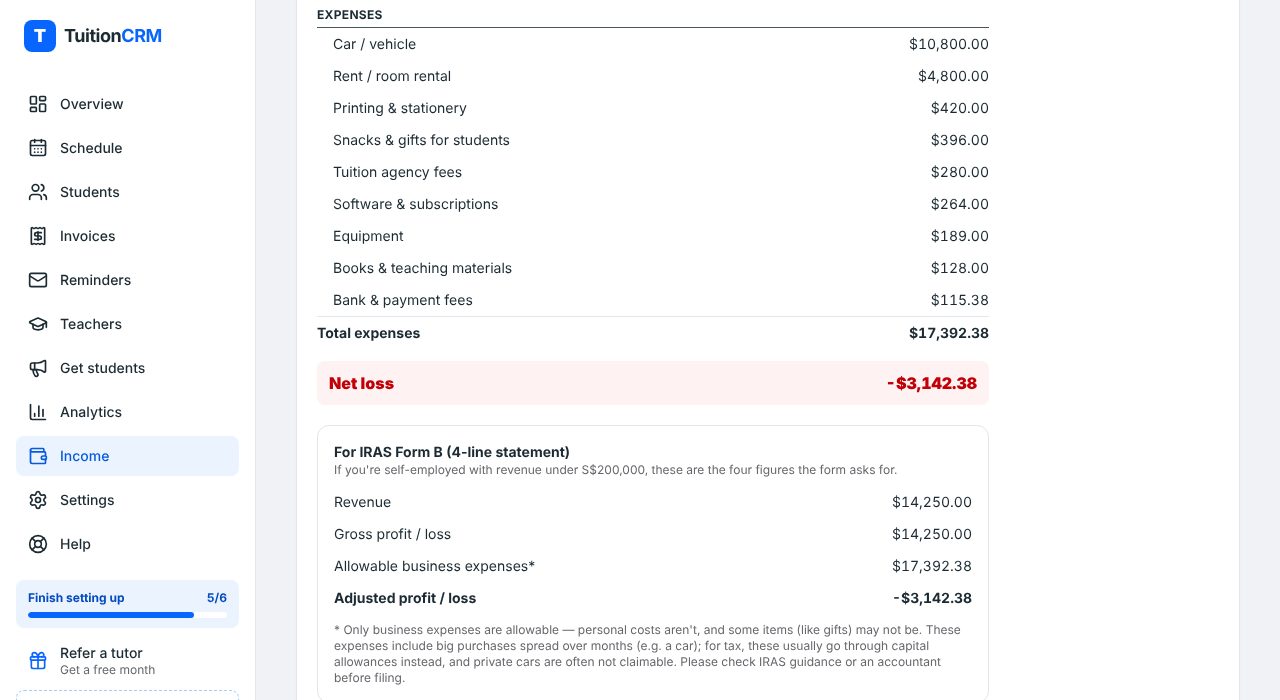
Net trade income is your tuition fees minus allowable business expenses, capital allowances and trade losses. It's the same adjusted profit you declare on IRAS Form B. So every allowable expense you record (assessment books, printing, transport to students' homes, agency commission) lowers your income tax and your MediSave.
Self-employed MediSave rates for tutors
The rate depends on two things: your age on 1 January of the year you earned the money, and your net trade income for that year. These are the rates for income earned in 2025 (Year of Assessment 2026), as published by IRAS:
| Net trade income in 2025 | Below 35 | 35 to below 45 | 45 to below 50 | 50 and above |
|---|---|---|---|---|
| Above S$6,000 to S$12,000 | 4% | 4.5% | 5% | 5.25% |
| Above S$12,000 to S$18,000 | 4% rising to 8% | 4.5% rising to 9% | 5% rising to 10% | 5.25% rising to 10.5% |
| Above S$18,000 | 8% | 9% | 10% | 10.5% |
| Most you pay in a year | S$7,104 | S$7,992 | S$8,880 | S$9,324 |
Between S$12,000 and S$18,000 the rate is phased in, so it climbs gradually rather than jumping. Above S$18,000 it's a flat percentage until you reach the cap. The cap works out to the full rate on about S$88,800 of net trade income: earn more than that and you still pay the maximum, not more.
Rates for 2026 income are set by the CPF Board and can change. When you're working out your own bill, use the official Self-Employed MediSave Contribution Calculator with your age and net trade income.
What tutors actually pay: four examples
These use the 2025 rates above. Ages are as at 1 January 2025.
| Tutor | Net trade income | Rate | MediSave for the year |
|---|---|---|---|
| Uni student, 22, tutors two P4 English students | S$5,500 | Below S$6,000 | S$0 |
| Part-time JC tutor, 28, weekends only | S$9,000 | 4% | S$360 |
| Full-time home tutor in Tampines, 38: S$60,000 fees minus S$8,000 expenses | S$52,000 | 9% | S$4,680 |
| Ex-MOE teacher, 52, Sec 3–4 and O-Level classes | S$110,000 | 10.5% (capped) | S$9,324 |
The ex-MOE teacher's 10.5% would be S$11,550, but the cap stops it at S$9,324. A tutor aged 30 with S$15,000 of net trade income falls in the phase-in band, so they'd pay somewhere between S$600 (4%) and S$1,200 (8%); the CPF calculator gives the exact figure.
Notice how much the full-time tutor's expenses matter. If they forgot to record S$3,000 of transport and books, their net trade income would be S$55,000 and their MediSave S$270 higher, on top of the extra income tax.
When the MediSave bill arrives
This is what catches most new tutors out: you pay MediSave the year after you earn the money, in one bill. Here's the timeline for money earned in 2026:
| When | What happens |
|---|---|
| Jan–Dec 2026 | You teach and collect fees by PayNow, cash or bank transfer |
| 1 Mar to mid-Apr 2027 | You file your tax return with IRAS, declaring tuition on Form B (the e-filing deadline has been 18 April in recent years) |
| After IRAS assesses you | IRAS sends your tax bill, and the CPF Board sends a notice with your MediSave amount |
| Within 30 days of the CPF notice | You pay, in full or through an instalment plan agreed with the CPF Board |
Since 1 November 2024, the MediSave notice comes from the CPF Board, not from IRAS. You can pay online, including by PayNow, or ask the CPF Board for instalments. Your contribution goes into your own MediSave Account, and compulsory MediSave you've paid gets tax relief in full the following year.
If your tuition income grew a lot this year, the MediSave bill next year (plus income tax) can easily be a month or two of fees. That's why it pays to save for it now.
How to save for MediSave without a shock
You can do this with a notebook, a spreadsheet or your banking app. It takes a few minutes a month:
- Work out your profit each month. Fees received minus business expenses. Count fees on the day the money arrives, not the day you sent the invoice.
- Pick your percentage. Use the full rate for your age from the table: 8% if you're below 35, 9% from 35, 10% from 45 and 10.5% from 50. If your yearly net trade income will be under S$12,000, the lower rates apply, but saving a little extra does no harm.
- Move that amount out on payday. A separate savings account works well. A tutor aged 38 with S$4,000 of profit in October moves S$360.
- Add income tax on top. Many tutors move MediSave and an estimate of income tax together, so the account covers both bills next year.
- Check once a quarter. If your income jumped (exam season often does this), top up the account. If you've already put away the cap for your age, stop saving for MediSave.
Two things not to do: don't record MediSave as a business expense (it isn't one, and it gets tax relief separately), and don't leave your expenses until March. A year of PayNow transfers and shop receipts is hard to piece together afterwards. If your rates don't leave room for MediSave and tax, it may be time to rethink what you charge.
The faster way: let TuitionCRM keep the numbers
The hard part of MediSave isn't the percentage. It's knowing your real net trade income, month by month, without a spreadsheet. TuitionCRM's income and tax tracker does that from the invoices you already send:
- When a parent pays, click Paid on the invoice. It counts towards your income on the day the money arrived.
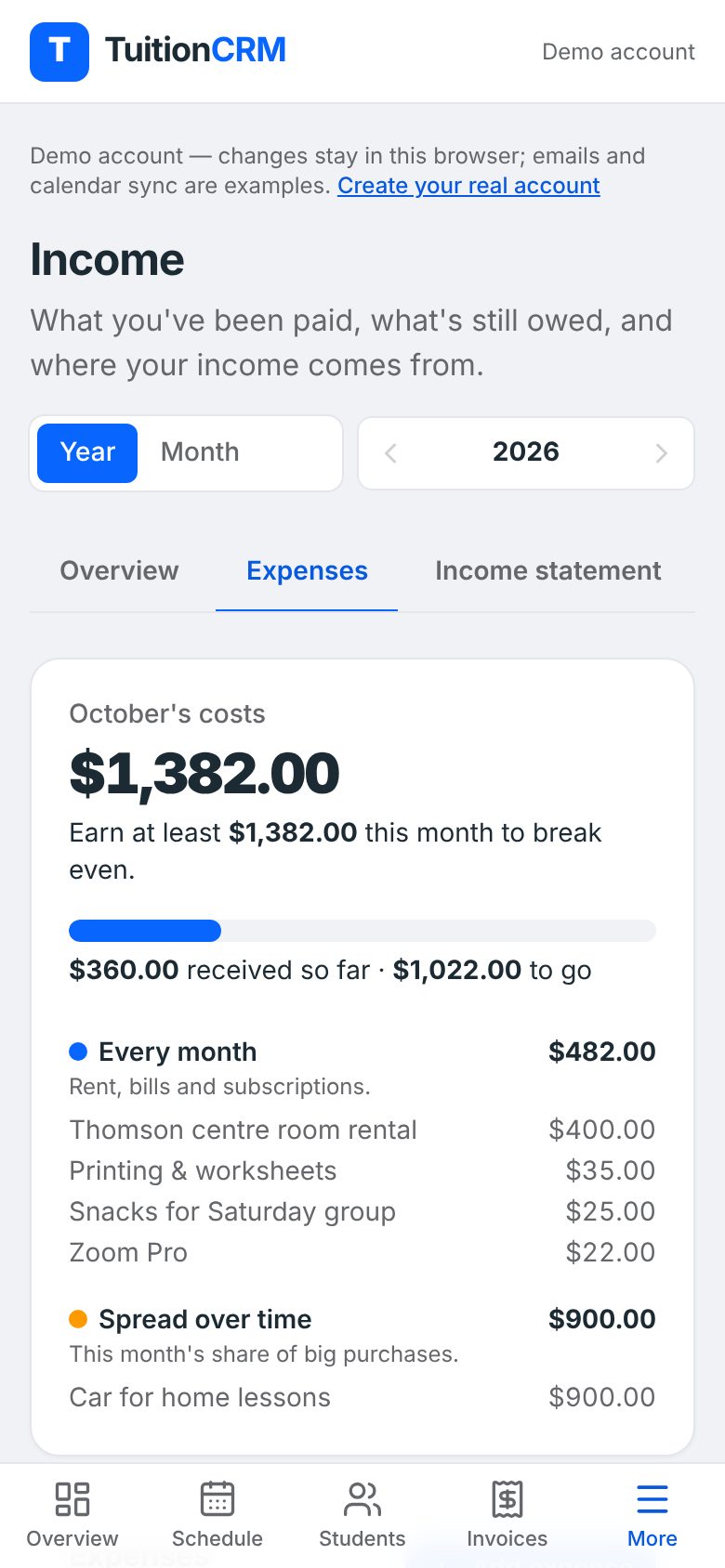
- Go to Income and open the Expenses tab. Click Add expense for rent, printing, books, transport or agency fees. Choose Every month for fixed costs so you only add them once.
- At the top of Expenses, the month's costs and what you've received so far show you how much of the month is profit.
- Open the Income statement tab and choose Year. The box For IRAS Form B shows your Revenue, Gross profit, Allowable business expenses and Adjusted profit. Your adjusted profit is the figure your net trade income, and so your MediSave, is based on.
- Multiply the adjusted profit by your rate from the table to see roughly what MediSave you'll owe, then click Send to accountant or download Excel or PDF when it's time to file.
The income tracker is part of the Pro, Pro Plus and Centre plans. There's a step-by-step guide to getting your income statement for your tax return in our Help pages.
MediSave isn't a penalty for being self-employed: it's your own savings for hospital bills and insurance premiums. It only hurts when the bill arrives unplanned. Know your net trade income, put your percentage aside each month, and next year's CPF notice becomes a transfer you were ready for.
Common questions
I have a full-time job and only tutor on weekends. Do I still pay self-employed MediSave?
Generally yes. The CPF from your salary covers your job, not your tuition. If your net trade income from tuition is more than S$6,000 in a year, CPF Board will ask for MediSave on that income too. If you're unsure, check your own case with the CPF Board.
Can I pay MediSave in instalments?
Yes, you can ask CPF Board for an instalment plan instead of paying the full amount in one go. Ask early, before the 30 days on your notice are up. Paying by GIRO also means you don't have to remember the date.
Does my MediSave contribution reduce my income tax?
Yes. Compulsory MediSave you paid as a self-employed person gets tax relief in full in the next Year of Assessment. It's added for you, so you don't need to claim it on Form B.
What can the money in my MediSave Account be used for?
It stays your own money. You can use it for hospital bills, some outpatient treatments, and the premiums for MediShield Life and Integrated Shield plans, for yourself and your family.
I'm a foreigner tutoring in Singapore. Does this apply to me?
No. Compulsory MediSave for the self-employed applies to Singapore Citizens and Permanent Residents. Foreigners also need the right pass to give tuition at all, so check with the Ministry of Manpower first.